Sunday, October 20, 2013

Additional music questions

Consider concert A - 440 Hz.  Find the following:

1.  The frequencies of the next two A's, one and two octaves above.

2.  The frequency of the A below concert A.

3.  The frequency of A#, one semi-tone (piano key or guitar fret) above concert A.

4.  The frequency of C, 3 semi-tones above A.

5.  The wavelength of the 440 Hz sound wave, assuming that the speed of sound is 340 m/s.

Wednesday, October 16, 2013

The Doppler Effect


The Doppler Effect

http://www.lon-capa.org/~mmp/applist/doppler/d.htm

http://falstad.com/mathphysics.html
Run the Ripple tank applet -
http://falstad.com/ripple/

The key in the Doppler effect is that motion makes the "detected" or "perceived" frequencies higher or lower.

If the source is moving toward you, you detect/measure a higher frequency - this is called a BLUE SHIFT.

If the source is moving away from you, you detect/measure a lower frequency - this is called a RED SHIFT. Distant galaxies in the universe are moving away from us, as determined by their red shifts. This indicates that the universe is indeed expanding (first shown by E. Hubble). The 2011 Nobel Prize in Physics went to local physicist Adam Riess (and 2 others) for the discovery of the accelerating expansion of the universe. Awesome stuff!

http://www.nobelprize.org/nobel_prizes/physics/laureates/2011/

It's worth noting that the effect also works in reverse. If you (the detector) move toward a sound-emitter, you'll detect a higher frequency. If you move away from a detector move away from a sound-emitter, you'll detect a lower frequency.

Mind you, these Doppler effects only happen WHILE there is relative motion between source and detector (you).

And they also work for light. In fact, the terms red shift and blue shift refer mainly to light (or other electromagnetic) phenomena.

Music!

In western music, we use an "equal tempered (or well tempered) scale."  It has a few noteworthy characteristics;

The octave is defined as a doubling (or halving) of a frequency.

You may have seen a keyboard before.  The notes are, beginning with C (the note immediately before the pair of black keys):

C
C#
D
D#
E
F
F#
G
G#
A
A#
B
C

(Yes, I could also say D-flat instead of C#, but I don't have a flat symbol on the keyboard.)

There are 13 notes here, but only 12 "jumps" to go from C to the next C above it (one octave higher).  Here's the problem.  If there are 12 jumps to get to a factor of 2 (in frequency), making an octave, how do you get from one note to the next note on the piano?  (This is called a "half-step" or "semi-tone".)

The well-tempered scale says that each note has a frequency equal to a particular number multiplied by the frequency that comes before it.  In other words, to go from C to C#, multiply the frequency of the C by a particular number.

So, what is this number?  Well, it's the number that, when multiplied by itself 12 times, will give 2.  In other words, it's the 12th root of 2 - or 2 to the 1/12 power.  That is around 1.0594.

So to go from one note to the next note on the piano or fretboard, multiply the first note by 1.0594.  To go TWO semi-tones up, multiply by 1.0594 again - or multiply the first note by 1.0594^2.  Got it?


Wave problems


1.  Differentiate between mechanical and electromagnetic waves.  Give examples.

2.  Draw a wave and identify the primary parts (wavelength, crest, trough, amplitude).

3.  Find the speed of a 500 Hz wave with a wavelength of 0.4 m.

3.  What is the frequency of a wave that travels at 24 m/s, if 3 full waves fit in a 12-m space?  (Hint:  find the wavelength first.)

4.  Approximately how much greater is the speed of light than the speed of sound?

5.  Draw the first 3 harmonics for a wave on a string.  If the length of the string is 1-m, find the wavelengths of these harmonics.

6.  Show how to compute the wavelength of WTMD's signal (89.7 MHz).  Note that MHz means 'million Hz."

7.  Explain the Chladni plate seen in class.

8.  A C-note vibrates at 262 Hz (approximately).  Find the frequencies of the next 2 C's (1 and 2 octaves above this one).

Wednesday, October 9, 2013

Introduction to Waves

There are 2 primary categories of waves:

Mechanical – these require a medium (e.g., sound, guitar strings, water, etc.)

Electromagnetic – these do NOT require a medium and, in fact, travel fastest where is there is nothing in the way (a vacuum). All e/m waves travel at the same speed in a vacuum (c, the speed of light)

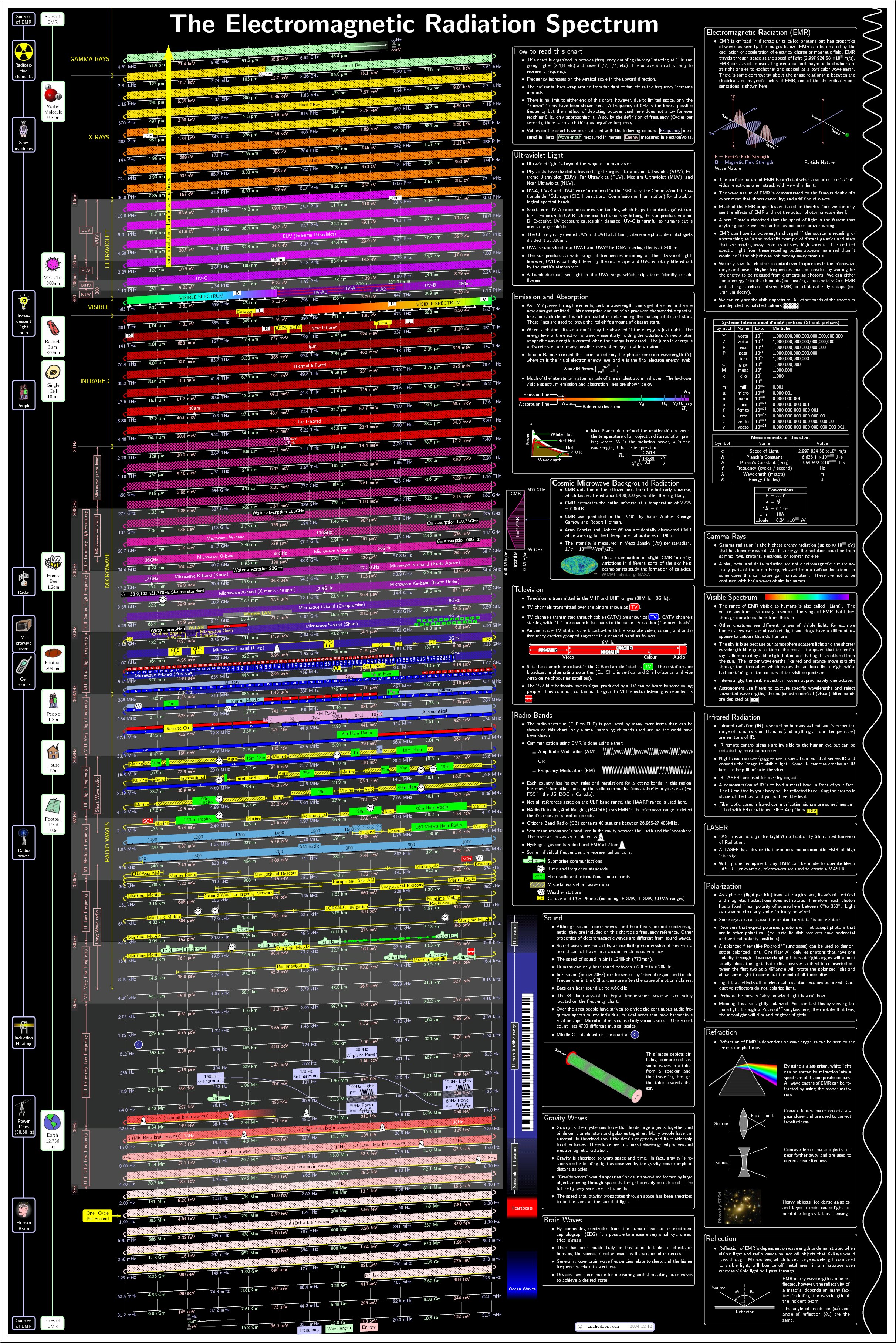
General breakdown of e/m waves from low frequency (and long wavelength) to high frequency (and short wavelength):

Radio
Microwave
IR (infrared)
Visible (ROYGBV)
UV (ultraviolet)
X-rays
Gamma rays

In detail, particularly the last image:


Waves have several characteristics associated with them, most notably: wavelength, frequency, speed. These variables are related by the expression:

v = f l


speed = frequency x wavelength

(Note that 'l' should be the Greek symbol 'lambda', if it does not already show up as such.)

For e/m waves, the speed is the speed of light, so the expression becomes:

c = f l


Note that for a given medium (constant speed), as the frequency increases, the wavelength decreases.

Note the units:


Frequency is in hertz (Hz), also known as a cycle per second.

Wavelength is in meters or some unit of length.

Speed is typically in meters/second (m/s).

Sound waves

In music, the concept of “octave” is defined as doubling the frequency. For example, a concert A is defined as 440 Hz. The next A on the piano would have a frequency of 880 Hz. The A after that? 1760 Hz. The A below concert A? 220 Hz. Finding the other notes that exist is trickier and we’ll get to that later.

Waves can “interfere” with each other – run into each other. This is true for both mechanical and e/m waves, but it is easiest to visualize with mechanical waves. When this happens, they instantaneously “add”, producing a new wave. This new wave may be bigger, smaller or simply the mathematical sum of the 2 (or more) waves. For example, 2 identical sine waves add to produce a new sine wave that is twice as tall as one alone. Most cases are more complicated.

In music, waves can add nicely to produce chords, as long as the frequencies are in particular ratios. For example, a major chord is produced when a note is played simultaneously with 2 other notes of ratios 5/4 and 3/2. (In a C chord, that requires the C, E and G to be played simultaneously.) Of course, there are many types of chords (major, minor, 7ths, 6ths,…..) but all have similar rules. In general, musicians don’t remember the ratios, but remember that a major chord is made from the 1 (DO), the 3 (MI) and the 5 (SO). It gets complicated pretty quickly.

We looked at specific cases of waves interfering with each other – the case of “standing waves” or “harmonics.” Here we see that certain frequencies produce larger amplitudes than other frequencies.  There is a lowest possible frequency (the resonant frequency) that gives a “half wave” or “single hump”. Every other harmonic has a frequency that is an integer multiple of the resonant frequency. So, if the lowest frequency is 25 Hz, the next harmonic will be found at 50 Hz – note that that is 1 octave higher than 25 Hz. Guitar players find this by hitting the 12th fret on the neck of the guitar. The next harmonics in this series are at 75 Hz, 100 Hz and so on.

Thursday, October 3, 2013

Answers to Gravitation questions


1.  Explain the meaning of "inverse square law".

The force (of gravity, in this case) gets progressively weaker by the factor 1 over the distance squared.  Double the distance --> force is 1/4 as great as it was.  Triple the distance --> force is 1/9 the original.

2.  Discuss each of Kepler's 3 laws.

See notes.

3.  At what point in its orbit is the Earth closest to the Sun?

Perihelion, which is approximately January 3 each year.

4.  At what point in its orbit is the Earth moving fastest?

Same point as 3 above.

5.  What causes seasons?

Tilt of Earth's axis.

6.  What is a semi-major axis of orbit (a)?

Half the longest distance across the orbital path (ellipse).

7.  What is an Astronomical Unit (AU)?

Defined as the semi-major axis of Earth's orbit - roughly 93,000,000 miles - or  half the longest width across Earth's orbit.

8.  Consider Jupiter.  It's orbit is 5 AU in size (roughly).  How long should it take Jupiter to orbit the Sun once?  Show how this calculation would be done.

5^3 = T^2

So, T = the square root of 125.

9.  What is the period of Earth's orbit around the Sun?

1 year, or approximately 365.25 days.

10.  What is the size of Earth's orbit (in AU)?

Defined as 1 AU.

11.  When you stand on the Earth's surface, you experience your "normal" Earth weight.  What would happen to your Earth weight if you were one Earth radius above the surface?  (That's twice as far from the center as simply standing on the surface.)

1/4 your surface weight.

12.  What does gravitational force between 2 objects depend on?

mass of the objects; distance between; a universal (unchanging) constant (G)